
Financials · Notes
Why doesn't my commission income match my P&L?
Short answerThe Book estimates annual commission earning power on policies in force. The P&L records commission booked during accounting periods. Compare the same twelve months, show growth to today's Book separately, and leave any remaining difference unexplained until the records support a cause.

John RanieriFounder & Product Lead, Keelridge SoftwareAugust 17, 2026 · 4 min read
Are the two numbers even supposed to match?
Not exactly, even when both records are complete. The Book is a point-in-time estimate of annual earning power. The P&L is a flow of commission booked between dates.
Keelridge's Book figure combines commission recorded in the AMS, annualization of supported six-month terms, and a modeled amount for direct-bill policies whose commission is recorded as zero. It describes what the current in-force Book is expected to support annually; it is not a receivable or a promise of cash.
The general ledger reports booked P&C commission on the agency's accounting basis. That may differ from cash received, and its timing follows the agency's posting process rather than the current shape of the Book.
A useful reconciliation preserves those bases and compares a year with a year. It does not force one day's Book estimate to equal one month—or even one trailing year—of accounting activity.
What has to be made comparable first?
Scope before arithmetic. The ledger side should contain the P&C commission accounts represented by the AMS Book. Contingent profit-sharing, life and health commission, and other income need their own analysis when they are not represented in that Book.
The Book side needs one consistent annual basis. Six-month terms cannot remain at half-year premium and commission while twelve-month terms remain annual. Direct-bill zeroes also cannot silently mean that the agency earns nothing when the source file simply omitted the rate.
These are governed setup decisions, not balancing items. Contingent income is not a convenient explanation for a P&C commission difference if it was already removed from the ledger scope, and a modeled direct-bill amount belongs inside the disclosed earning-power estimate rather than being added again as a gap cause.
Why use a twelve-month average of the Book?
A trailing-twelve-month P&L contains commission produced by the Book as it existed throughout those twelve months. Comparing it only with today's larger or smaller Book makes growth look like an accounting discrepancy.
Instead, calculate earning power at each available Book snapshot across the same twelve accounting months and average those readings. Compare the booked P&C commission for that window with that average. Then show the change from average earning power to earning power today as a separate growth rung.
That sequence distinguishes a year-to-year operating change from the residual difference between the ledgers. It also prevents a rapidly growing Book from manufacturing a large apparent shortfall merely because today's position is being compared with yesterday's revenue.
What does timing and unexplained mean?
It is booked P&C commission for the twelve-month window minus average Book earning power for those same months. The result stays signed: the ledger can sit above or below the Book estimate.
The label is intentionally modest. Posting timing, statement practices, source omissions, commission assumptions, retention, and other effects may sit inside the difference, but the two ledgers do not prove how much belongs to each cause. Calling the full remainder an unmatched deposit, a retention loss, or a direct-bill backlog would claim evidence the comparison does not contain.
Keelridge reads the latest result against the agency's own history rather than declaring one universal acceptable percentage. A result outside that usual range is a reason to investigate source timing and setup; it is not an automatic diagnosis.
What does a good monthly reconciliation actually look like?
Use one repeated bridge: booked GL P&C commission for the trailing twelve months; less the signed timing-and-unexplained difference; equals average Book earning power for those same months; plus or minus Book growth over the window; equals earning power today.
Keep the recorded, annualized, and modeled portions of earning power visible. State which GL accounts are in scope. Show the residual trend and the agency-specific usual range without assigning the remainder to a cause the data cannot support.
The output should let an owner distinguish a changing Book from a changing ledger and then open the underlying evidence. It is not a single total engineered to agree.
What this looks like in practice
A year of ledger beside a year of Book earning power.
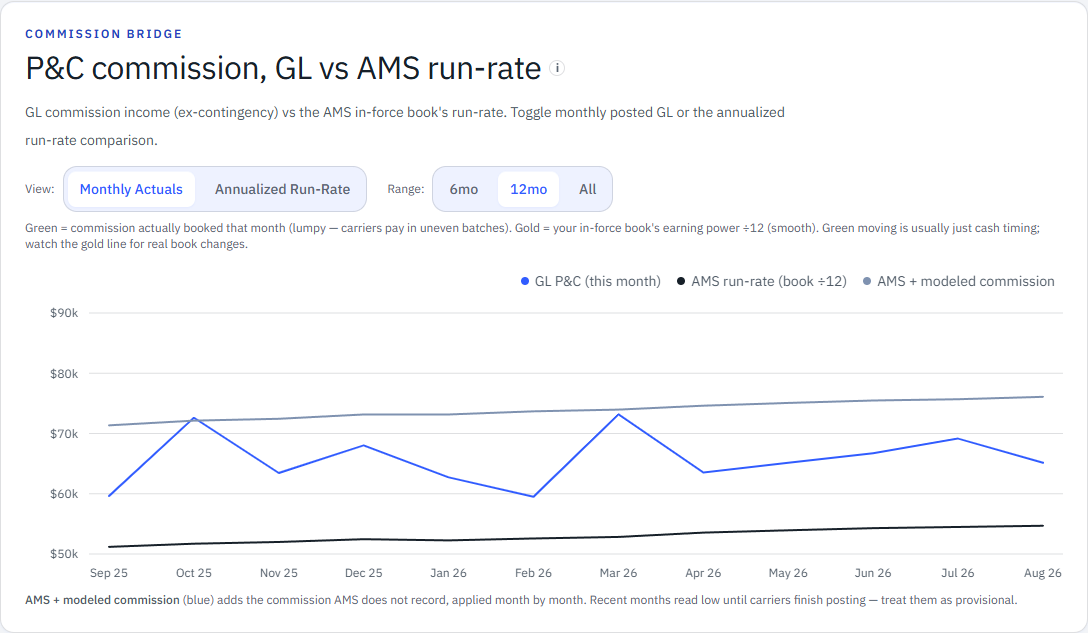 Owner viewOpen this page in the live demo →
Fictional Keelridge Demo Agency. The live reconciliation compares booked GL P&C commission with average earning power on the same trailing-twelve-month window, separates growth to today's earning power, and leaves timing and unexplained visible without assigning it a cause. On the monthly chart, dots show the Book's commission by term start beside the posted GL bars.
What to do with this in your own review
Define the P&C commission accounts in scope, build annual earning power on a consistent basis, and compare the trailing year of booked GL commission with the Book's average earning power over those same months. Show growth to today separately and preserve the remaining signed difference as timing and unexplained until source evidence supports a narrower conclusion.
Sources used for the industry context
- Vertafore — AMS360 accrual posting for direct billVendor documentation showing that policy effective dates, carrier commission statements, reconciliation entries, and general-ledger postings can occur on different dates.
- Agency Accounting — Direct Bill CommissionsIndustry training material describing multiple valid direct-bill recording methods and the tradeoff between policy-level detail, timing, and control.