
Guided owner tour · 5 steps
Do the book and booked commission tell the same story?
Bring Book earning power and booked P&C commission into one management review. Compare the same twelve months, see how earning power has changed and investigate the remaining difference before deciding what needs attention.
KEELRIDGE SOFTWARE · REVIEWED · Screens come from a fictional, read-only agency.
 Owner viewOpen this page in the live demo →
The short answer
Start with a fair comparison. Investigate what remains.
Are we comparing like with like?
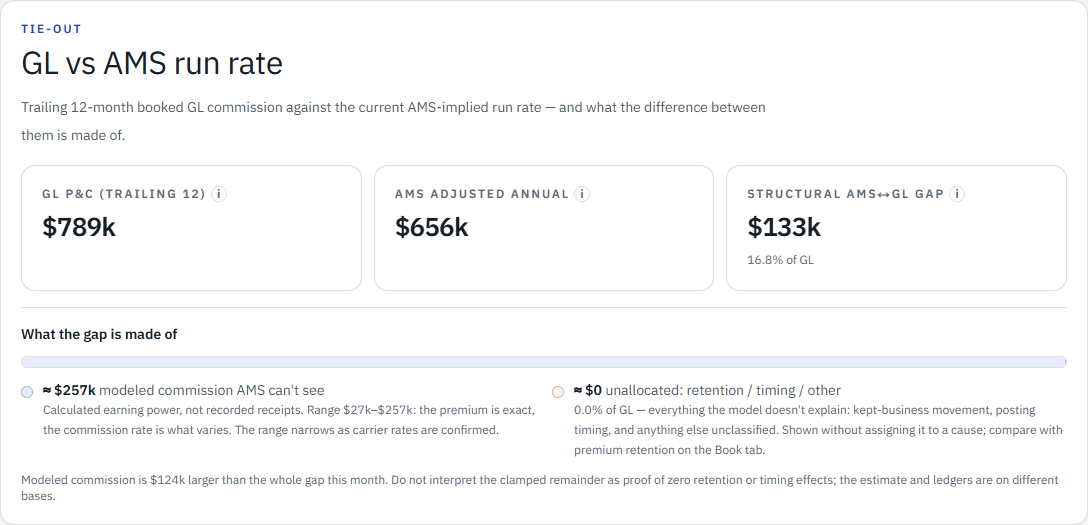
Put a year of booked P&C commission beside Book earning power averaged over the same months. Keep the scope and dates visible.
What is behind the difference?
Inspect the Book estimate, separate growth to the selected snapshot and read what remains against the available agency history.
Where should the review go next?
Use the comparison to choose a source check or finance conversation. People establish the explanation and own follow-through.
What are the two figures telling us?
Booked commission describes what the agency recorded as income over a period. Book earning power describes the recurring annual commission represented by policies in force at a snapshot. Review them together to understand how the business being serviced relates to the income being booked.
The AMS and accounting records may live in one platform or separate systems. Their purposes still differ: an annualized Book position and a booked flow need an agreed basis before the owner can interpret the gap.
Read the complete explanation of the two records →
Owner viewOpen this page in the live demo →
Are both sides on the same basis?
Compare the same period and the same scope. Read booked P&C commission beside earning power averaged over those same months, so changes in the book do not become a misleading accounting concern.
Use the twelve calendar months ending at the earlier of the last closed GL month and the selected Book snapshot's month. Sum the agreed P&C commission accounts and average Book earning power for that window. If a required ledger month is missing, the comparison is withheld and the missing months are named.
Contingency, life and health and other income outside the P&C scope stay outside this comparison. The tie-out keeps its defined scope rather than following the P&L exclusion toggle.
Owner viewOpen this page in the live demo →
What goes into Book earning power?
Inspect the recorded and estimated components before relying on earning power. It combines AMS-recorded commission, a second term for supported six-month policies and modeled direct-bill commission where the AMS records zero.
The model uses supported agency rate evidence and remains labeled as an estimate, with a sensitivity range. Those components describe the Book's earning power; they are not assigned against the ledger difference to make the figures agree.
Inspect earning power in the owner demo →
Owner viewOpen this page in the live demo →
Does the difference deserve a closer look?
Read the signed difference against the reference range, using the agency's own history where enough is available. An unusual change gives the owner a starting point for investigation.
Timing & unexplained equals booked GL P&C commission minus window-average earning power. Growth from that average to earning power at the selected snapshot is shown separately. Both can move in either direction.
The monthly chart adds context: posted GL bars, AMS commission by term start as dots and monthly-average earning power as a line. The term-start series is a cross-check, not part of the tie-out.
The Keelridge Assistant supports authorized questions about the comparison and links answers back to evidence, helping the owner investigate without rebuilding the review. People decide which records or explanations to check next.
Inspect the monthly comparison in the fictional owner demo →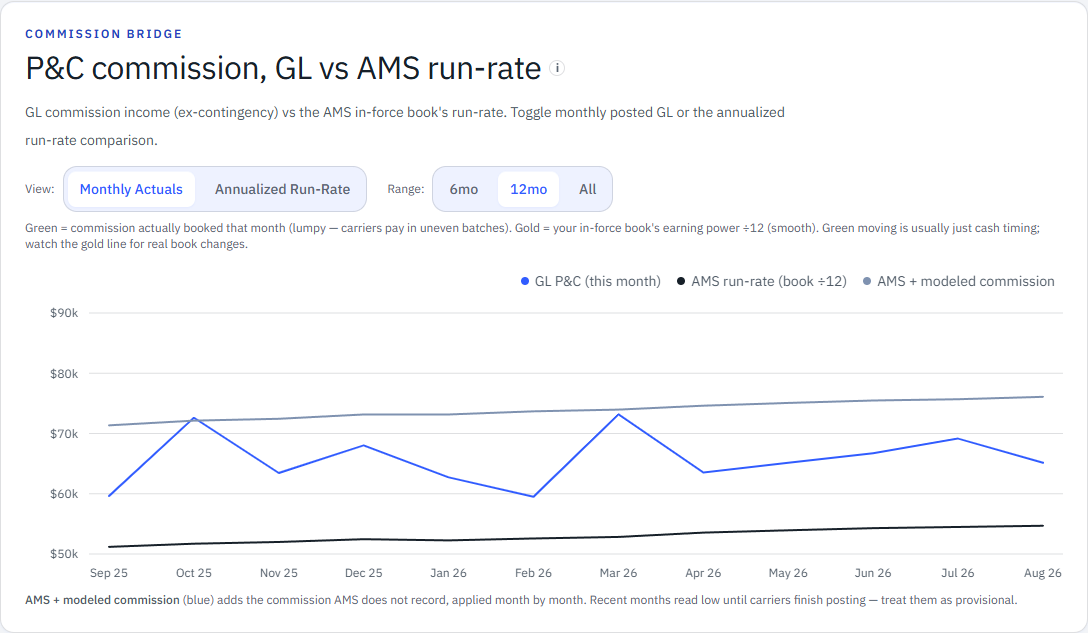 Owner viewOpen this page in the live demo →
Repeat the comparison. Follow the evidence.
The management picture should not have to be assembled by hand every time the question returns. After mapping, authorized staff upload supported Book and accounting reports, review validation and confirm the update. The period, rate evidence, growth and signed remainder stay attached to the comparison.
Use it alongside financial, book and team performance to decide where attention belongs. Commission and agency economics remain in authorized executive or finance views; give managers and account teams only the context their roles permit. People own source checks and follow-through, while accounting and the AMS remain authoritative. Supported reports can be refreshed whenever they are available.
See how recurring sources become a management review →Before drawing a conclusion
Keep the comparison and the explanation separate.
- Use the stated period and scope.Booked P&C commission and average Book earning power cover the same window. Missing source history or unavailable evidence must be addressed before relying on the comparison.
- Keep estimates visible.Modeled direct-bill commission stays inside earning power, with its range. It is not an explanation for missing ledger income.
- Establish causes from evidence.Timing & unexplained can be positive or negative. Posting lag, churn and other causes are not automatically assigned to it.
- Keep financial responsibility clear.This is not bank reconciliation or a controlled ledger reconciliation. Carrier statements, deposits and accounting close remain in their authoritative workflows.
Questions from agency owners
Before drawing a conclusion from the difference.
Why can AMS commission differ from the insurance agency general ledger?
The AMS Book estimates annual earning power from policies in force, while the general ledger records booked P&C commission across accounting periods. Keelridge compares a trailing year of ledger activity with the Book's average earning power over those same months, then keeps the remaining signed difference visible as Timing & unexplained.
Read the note →How should an agency compare AMS commission with booked income?
Define the P&C commission accounts in scope, then compare trailing-twelve-month booked GL commission with earning power averaged over those same months. Show growth from that average to the selected snapshot separately, and leave Timing & unexplained unassigned. The Keelridge Assistant supports authorized questions about the comparison and links answers to evidence. Its public-demo launcher opens a notice rather than running analytical chat.
What is included in Book earning power?
Earning power includes commission recorded in the AMS, the second term of supported six-month policies and a modeled amount for direct-bill business whose agency commission is recorded as zero. The model uses the supported rate evidence and carries an estimate and sensitivity range. These components belong inside earning power; they do not establish why the ledger differs.
What does Timing & unexplained mean?
Timing & unexplained is trailing-twelve-month booked GL P&C commission minus the Book's earning power averaged over those same months. The difference can be positive or negative. The reference uses the agency's own historical range when enough history is available, and the current default otherwise. A change can prompt investigation; neither the sign nor the label proves posting timing, churn or another cause.
Your agency’s commission questions
Start with the difference you need to understand.
Book a 30-minute owner walkthrough using fictional agency data. Discuss how you compare Book earning power with booked income today, which differences are hard to explain and who needs the resulting context. No agency files are needed for the conversation.
Review the design-partner pilot terms →