
Book of business · Notes
Did my insurance agency grow, or did premium rates just increase?
Short answerCompare the same Book at two dates. Separate premium lost with departing customers, premium gained with new customers, and change on customers who stayed. If most of the increase is on retained customers, the agency's Book grew without much customer growth.

John RanieriFounder & Product Lead, Keelridge SoftwareSeptember 10, 2026 · 5 min read
Why can a growing Book hide weak customer growth?
Annual in-force premium can increase while the agency loses more customer premium than it adds. Existing customers may renew at higher rates, increase payroll or sales, add property or vehicles, change coverage, or move among lines and carriers. Those changes enlarge the Book, but they do not prove the agency won more customers.
That distinction is especially important after a hard market. MarshBerry reported that roughly seven percentage points of an average firm's 10.2% organic growth in 2023 came from rate and exposure growth in the existing Book. Insurance Journal later described years of rate inflation as a force that could mask underlying organic growth. Those are industry examples, not benchmarks for an individual agency; the agency still has to decompose its own Book.
Does organic growth already remove rate increases?
Not under the common agency convention. The Big “I” and Reagan Consulting Foundations guide defines organic growth as year-over-year growth after removing acquisition, divestiture, contingent, investment, and miscellaneous-income effects. It also states that organic growth is still affected by rate, exposure change, retention, and new business. Keelridge's Organic Growth Rate follows that convention: growth in commissions and fees less brokerage, with contingent and other income left out and each purchased Book left out for its first 12 months.
So an organic-growth percentage and growth created by new customers are not interchangeable. Organic growth is useful, but an owner needs the movement beneath it before attributing the result to selling, service, or market conditions.
How do you separate customer movement from retained-Book change?
Use annual in-force premium on two dated AMS Book snapshots and make the bridge reconcile exactly. The opening and closing totals are stocks measured at points in time; every movement component belongs on the same annual basis.
You can work through the same bridge with the Book movement calculator when you already have the four inputs.
| Bridge component | How to identify it | What it means |
|---|---|---|
| Opening Book | Annual in-force premium at the first snapshot | The customer and premium base the agency started with |
| Lost customers | Present at opening and absent at closing | Opening premium that left the agency with those customers |
| Gained customers | Absent at opening and present at closing | Closing premium that arrived with those customers before further classification |
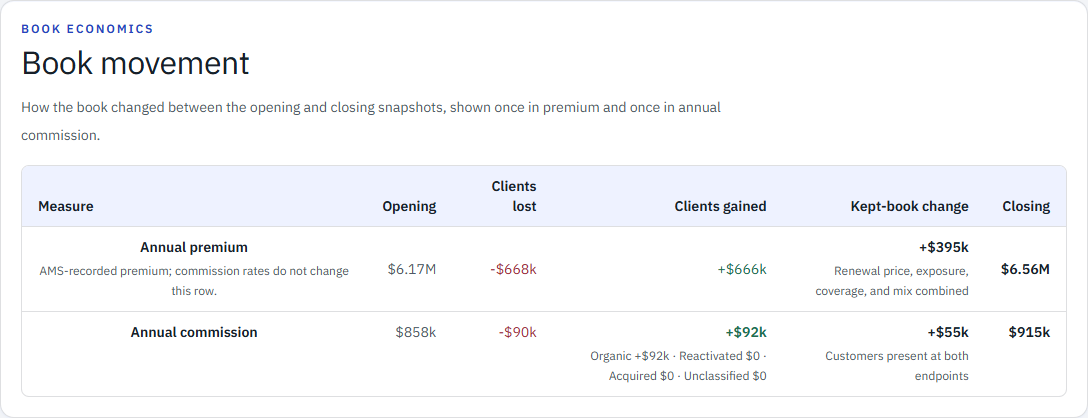
| Change on retained customers | Present at both endpoints | Closing minus opening premium for customers who stayed |
| Closing Book | Annual in-force premium at the second snapshot | Opening − lost + gained ± retained change; the bridge must land here |
Can change on retained customers be called a rate increase?
No. Two standard Book snapshots can show that premium changed on customers present at both dates. They usually cannot prove how much came from carrier rate, exposure, coverage, audit, limit, deductible, or account-mix changes.
Call the combined figure change on retained customers unless more detailed source evidence separates its causes. Describing the entire remainder as rate gives a precise explanation the source does not support.
Does gained premium always mean genuine new business?
No. A customer absent from the opening snapshot and present at the close is gained business on the point-to-point bridge, but that first classification does not explain how the customer arrived.
- Genuine new customer. The customer is new to the whole agency and did not arrive with a purchased Book.
- Reactivation. A former customer returned after being absent at the opening date.
- Acquired arrival. Existing business from a purchased Book was rebooked onto the agency's AMS during the acquisition period.
- Internal transfer. Responsibility moved between people or departments while the customer stayed with the agency. This is not agency growth or churn.
- Remarket. An existing customer moved to another carrier or policy identity. At the agency level the customer stayed, so it belongs with retained movement rather than one false loss and one false gain.
- Cross-sold line. An existing customer added a line or policy they did not hold before. This can be genuine new business without being a newly gained customer.
Which numbers should an owner read together?
Read total Book change beside client retention, premium retention, customers gained and lost, change on retained customers, and genuine new business. Client counts reveal whether the customer base expanded. Premium measures reveal where the dollars moved. The classified new-business view separates actual arrivals and cross-sell from administrative or purchased movement.
Then compare Book premium with commission earning power and booked revenue on their own bases. A larger premium Book does not guarantee that commission income posted at the same pace; commission rates, billing method, timing, contingencies, and exclusions can all change that relationship.
What does Keelridge automate each month?
A manual bridge is simple only after someone has found comparable snapshots, kept customer identity stable, annualized the premium consistently, classified arrivals, and checked that every component ties to the closing Book.
Keelridge maps those rules during implementation. When the agency supplies its regular AMS Book file, the product stages and validates the new period, compares it with the appropriate opening snapshot, and updates the movement, retention, new-business, and role-specific views. The owner sees what left, arrived, transferred, or changed among retained customers without rebuilding the cohorts in a spreadsheet.
The limits stay visible. Keelridge does not label retained change as rate without supporting evidence, and people continue to own opportunity status and corrections in the systems that hold the underlying records.
What this looks like in the demo
A closing total becomes an opening-to-closing bridge.
 Owner viewOpen this page in the live demo →
Fictional Keelridge Demo Agency. Lost customers, gained customers, and change on retained customers stay separate, so premium growth is not mistaken for customer growth.
Why the annual answer needs monthly context
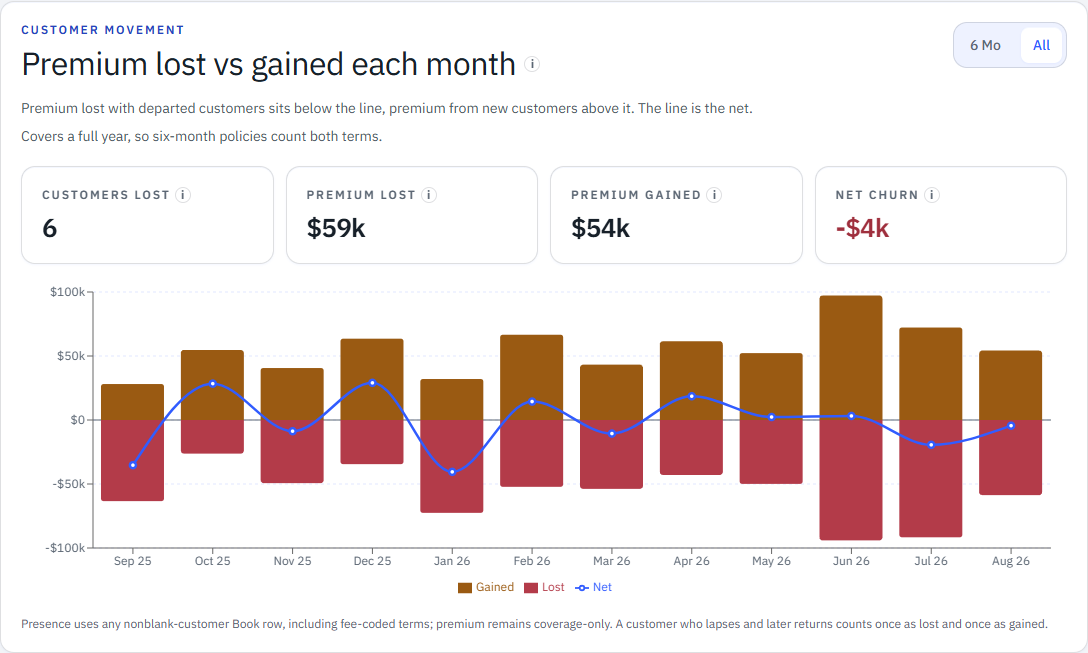
Customer flow and retained-Book movement do not arrive evenly.
 Owner viewOpen this page in the live demo →
Fictional Keelridge Demo Agency. Monthly movement shows whether one annual result reflects a steady pattern or a few concentrated periods.
A bigger Book is the beginning of the question
Compare the same Book at two dates and force opening premium, lost customers, gained customers, and retained-customer change to reconcile to closing premium. Then classify the arrivals and keep rate, exposure, coverage, and mix combined unless better evidence separates them. That tells an owner whether the agency expanded its customer base, rode market movement, or did some of both.
Sources used for the industry context
- Big “I” and Reagan Consulting — Best Practices Foundations: GrowthPublic guide defining conventional agency organic growth and its rate, exposure, retention, and new-business components.
- MarshBerry — Achieving “Real” Organic Growth Through True Value CreationIndustry analysis separating reported organic growth from rate and exposure growth in the existing Book.
- Insurance Journal — How to Grow an Agency in 2026Industry reporting on rate inflation masking agency growth and the renewed importance of retention and new business.