
Guided owner tour · 5 steps
What stayed with your agency?
Start with the customers you already served. Review which relationships stayed, what opening premium and commission stayed with them, and where changes deserve attention. Use the evidence to decide what to investigate next.
KEELRIDGE SOFTWARE · REVIEWED · Screens come from a fictional, read-only agency.
 Owner viewOpen this page in the live demo →
The short answer
Start with who stayed. Investigate what changed.
Which relationships did we keep?
Follow the opening customers to the ending date. Read relationship counts alongside the opening premium and commission those customers carried.
What does the gap tell us?
Compare client, premium and commission retention to see where account size or opening earning power changes the interpretation. Read renewal rate on its separate basis.
What needs attention next?
Use monthly movement to locate the change, then choose the next investigation or agency conversation. People own the follow-through.
Which customers are we measuring?
Choose the customers present at the opening snapshot and ask which of those same customers remain at the ending snapshot. New and acquired customers arriving during the period belong in the separate movement and growth review; they were not part of the opening group.
The view should state both dates, the Book segment, and the treatment of rewrites, remarkets, and missing identifiers before presenting a percentage.
Try the cohort formula in the public calculator →
Owner viewOpen this page in the live demo →
What do the four views tell us?
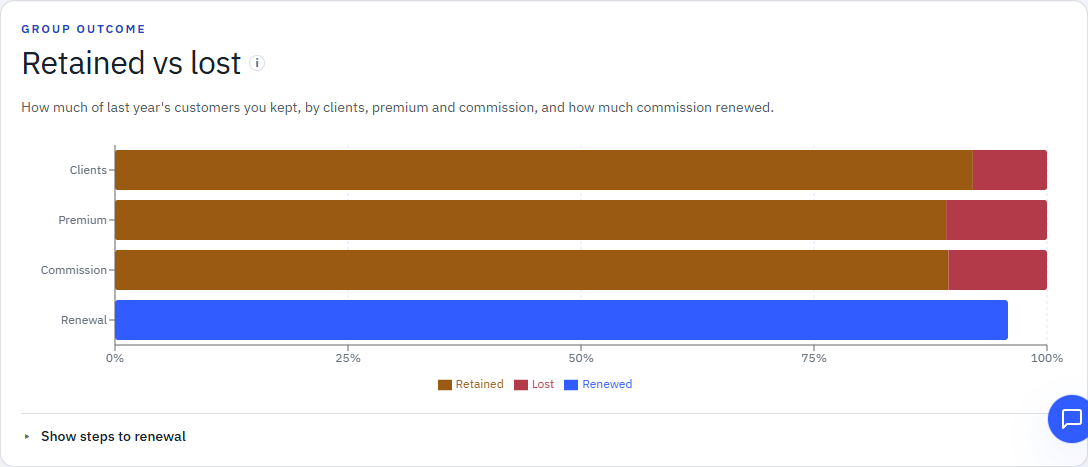
Client, premium and commission retention look at the same opening customer cohort using different weights. Renewal rate answers a separate question about renewed-line commission.
The first three follow one opening customer cohort. Client retention counts each opening customer once. Premium retention weights that cohort by opening annual in-force premium. Commission retention weights it by opening annual recurring commission represented in the AMS, with estimates disclosed. Each measures the opening count or value attached to customers who remain, divided by the opening cohort's total.
Commission retention is not booked commission income from the general ledger. The separate renewal rate compares current commission on renewed lines with opening-book commission, including supported replacement credit. It can reflect changes in renewal premium and commission; it is not a fourth identical opening-cohort ratio.
Compare all four views in the owner demo →
Owner viewOpen this page in the live demo →
Were the lost accounts larger or smaller?
Use the gap to decide where to look. If client retention is stronger than premium retention, the departing accounts carried more opening premium than average. A stronger premium measure means the departing accounts were smaller on that basis.
Later premium changes do not lift opening-weighted retention; they appear separately as change on retained customers. Commission retention adds the opening earning-power perspective, with its estimates and basis kept visible.
The Keelridge Assistant supports questions about authorized figures and links answers to evidence, helping the owner investigate without rebuilding the review.
Why client and premium retention can move apart →
Owner viewOpen this page in the live demo →
When did the book change?
The annual retention rate follows one opening cohort. The monthly movement chart answers a related but different question: when premium left with departed customers and arrived with new or returning customers. Read those arrivals as movement context alongside the opening-cohort result.
A lapse followed by a return can appear once as lost and once as gained in movement while still requiring a consistent rule in the annual cohort result.
Inspect monthly movement in the owner demo →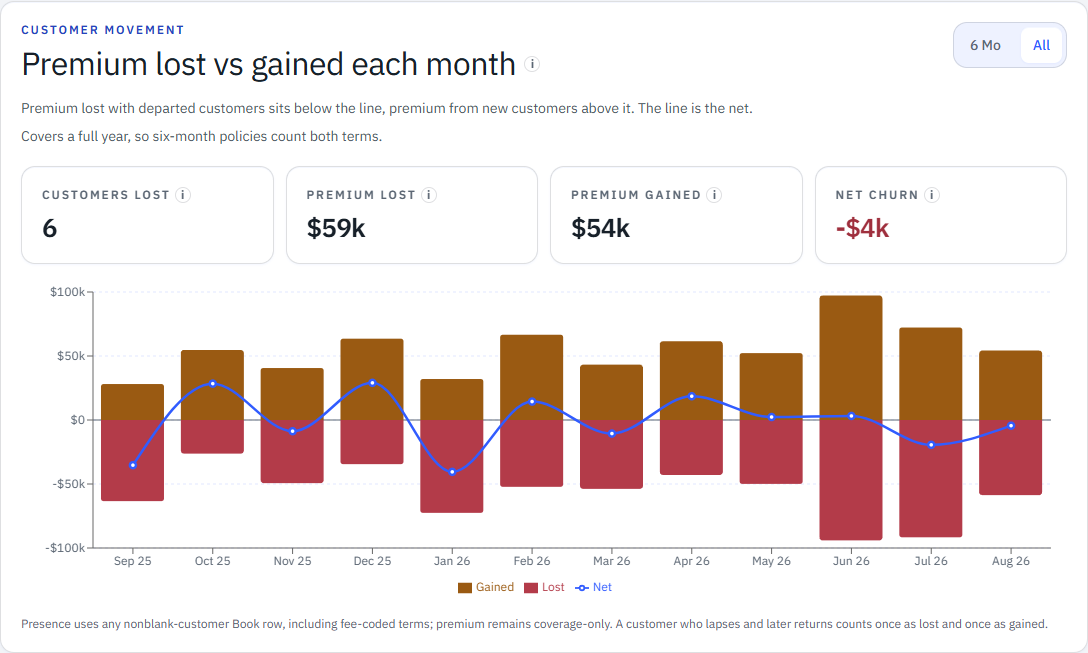 Owner viewOpen this page in the live demo →
Repeat the review. Follow through with context.
The public calculator is useful when the cohort totals are already known. Keelridge does the harder recurring work: after mapping, authorized staff upload supported AMS reports, review validation and confirm the update. Keelridge compares dated Book records using the agreed definitions, so management can start from the evidence without rebuilding the cohort from several reports each month.
A monthly conversation is a useful rhythm; supported uploads can happen whenever reports are available. Decide which changes need investigation, then give managers and account teams context within their roles. People own follow-up and authoritative insurance activity stays in the AMS.
See how recurring source files become a review →Before drawing a conclusion
Keep the evidence and responsibility clear.
- Use consistent dates and definitions.Compare the same opening relationships, weighting basis and reporting window.
- Investigate the reason with the agency.Customer presence in a Book export does not establish why someone left or who caused the result. Bring source records and human context into that conversation.
- Read growth separately from retention.New arrivals belong in the movement and growth review, outside the opening retention cohort.
- Give each role appropriate context.Commission retention and the commission-based renewal rate belong in the executive review. Managers and account teams use permitted assigned-team or own-book evidence.
Questions from agency owners
Before comparing one retention rate with another.
How do you calculate an insurance agency's retention rate?
Choose the customers present at the opening date, then measure how many of that same group remain at the ending date. Divide retained customers by opening customers for client retention; use the opening premium attached to customers who remain, divided by all opening-cohort premium, for premium retention. Commission retention weights that same cohort by its opening annual recurring commission, with estimates disclosed. The separate renewal rate compares current renewed-line commission, including supported replacement credit, with opening-book commission.
Read the note →Why are client retention and premium retention different?
Client retention counts each opening customer once, while premium retention weights that same cohort by opening account size. The measures diverge when the customers who leave are larger or smaller than the average opening customer. Later premium change on retained customers is reported separately.
Read the note →Does new business belong in an insurance agency retention calculation?
No. Retention follows the opening customer cohort forward, so customers acquired after the opening date are excluded from the retention numerator and denominator. Arrivals, departures and returns are also tracked in the separate movement view.
How often should an insurance agency review retention?
A monthly management conversation helps keep losses and movement current. Read the headline rates over a complete, consistently defined period, such as the trailing twelve months, and compare like-for-like windows. Authorized staff can upload supported reports when available; validation and confirmation precede the updated review.
Can the Keelridge Assistant help investigate retention?
The Keelridge Assistant supports questions about authorized figures and links answers to evidence. People bring agency context and decide what to do next. The public demo opens an Assistant notice rather than running analytical chat.
Your agency’s retention questions
Bring the changes you need to understand.
Book a 30-minute owner walkthrough using fictional agency data. Discuss how you review retention today, which changes are hard to explain and who needs the resulting context. No agency files are needed for the conversation.
Review the design-partner pilot terms →