
Guided account-team tour · 5 steps
See how assigned books are developing
Bring retention, growth and rounding into one team review. See what changed across assigned books, investigate the context and agree where people need support, without rebuilding separate reports before each conversation.
KEELRIDGE SOFTWARE · REVIEWED · Screens come from a fictional, read-only agency.
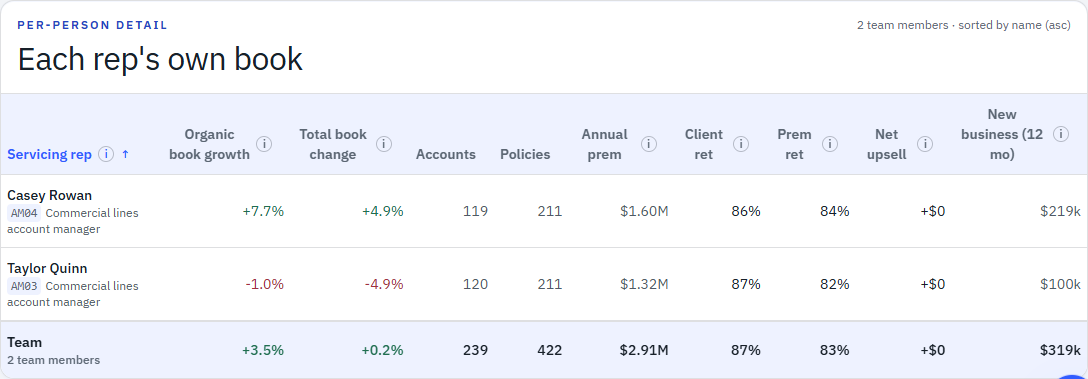 Department manager viewOpen this page in the live demo →
The short answer
One team review. Better questions for the conversation.
Where are assigned books changing?
Start with the assigned team, reporting period and role expectations. Read retention, growth, movement and rounding together.
What deserves a closer conversation?
Follow a change into its definitions and responsibility context. Check transfers, acquired business and the account manager’s explanation before drawing a conclusion.
Where does the team need support?
Bring workload and service quality into the conversation. People agree on coaching or follow-up and return to the evidence in the next review.
Which books and responsibilities are we reviewing?
Start with the assigned books, reporting period and what each role is responsible for. Current book size describes scale; the review needs retention, development and responsibility history to help explain what changed.
The Department Manager view puts assigned-team evidence in one review, with the reporting period visible. Use it to find the questions worth investigating and the people who may need support.
Explore the team view as Department Manager →
Department manager viewOpen this page in the live demo →
What changed in the assignment?
An internal transfer changes who services business without creating agency-wide growth or loss. Acquired arrivals add assigned business without making every purchased policy organic production. Use transfer and acquisition history to understand how book responsibility changed over the period.
Start with the same person over equivalent periods. Book size, mix, complexity, tenure, carrier changes and transfer history remain context for any comparison.
Read the complete measurement method →
Department manager viewOpen this page in the live demo →
Are relationships staying and developing?
Read retention, genuine growth, movement and rounding together. They answer different questions: whether relationships stayed, whether new business actually arrived, how retained customers changed, and whether existing relationships are developing.
Client retention counts opening relationships kept; premium retention weights the same cohort by its opening premium. Read Genuine new and lost business alongside the separate movement measures.
Distinguish new clients and added lines from returns, acquired arrivals and rewrites. Retained-book movement shows premium change among customers who stayed, including possible price or exposure changes. Rounding describes development of existing relationships; assigned-book premium provides scale.
The Keelridge Assistant supports investigation of authorized figures within the reader’s role scope.
Compare the team outcomes in the live demo →
Department manager viewOpen this page in the live demo →
What does the account manager see in their own book?
One agency context gives people different views for their responsibilities. An account manager’s My Book view brings together their own retention, movement, rounding and premium. Commission, agency-wide financials, and peer comparisons stay outside that view. The private evidence gives the account manager a starting point for the conversation.
Explore the fictional account-manager perspective →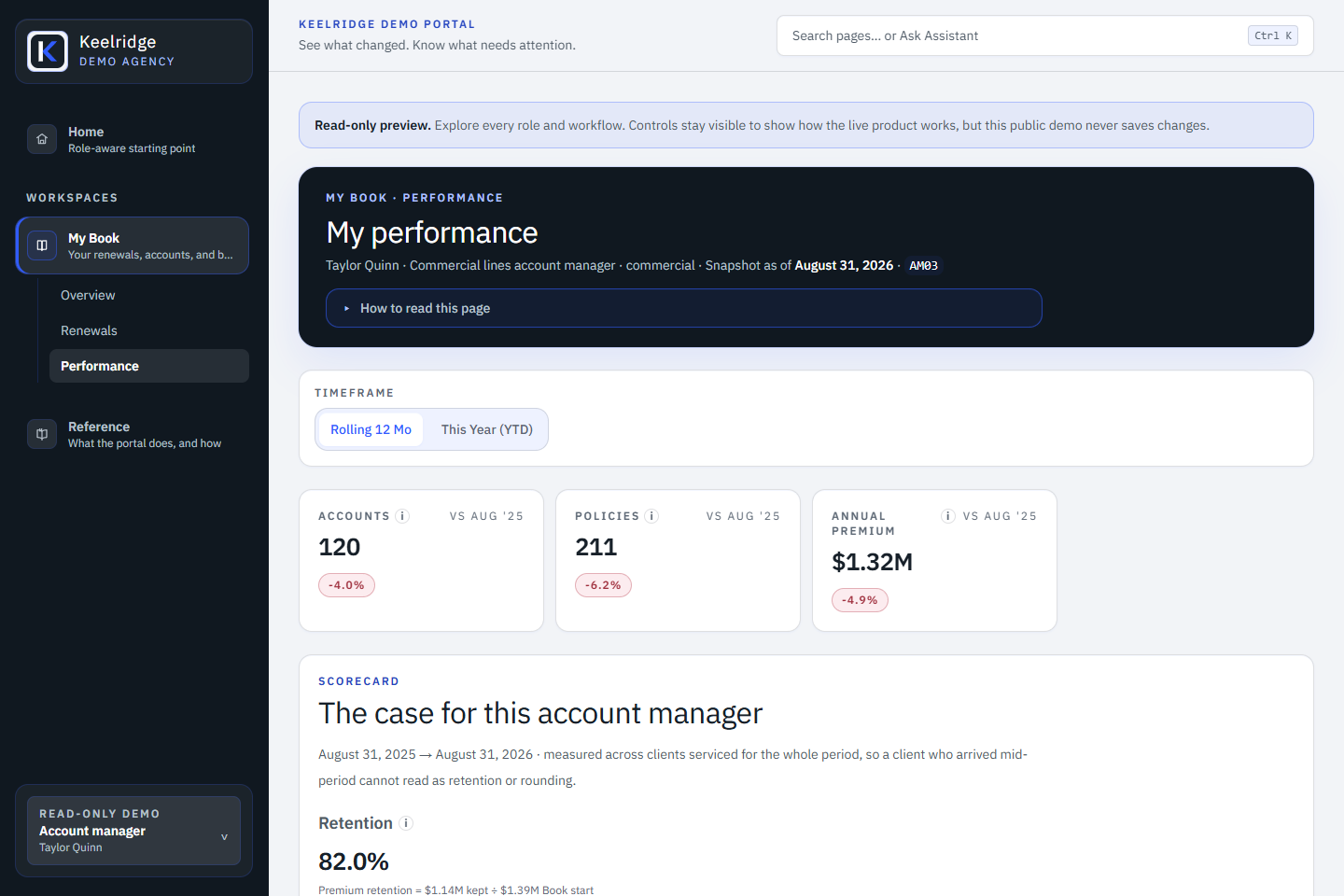 Account manager viewOpen this page in the live demo →
Agree on support. Return to the evidence.
After initial mapping, each supported report is checked and confirmed before the team review updates. Managers can return to consistent periods and definitions without rebuilding several account-manager reports before every meeting.
Use the conversation to agree where coaching, coverage or follow-up would help. People own those actions and return authoritative insurance activity to the AMS. A monthly review is a useful rhythm; supported source uploads are not limited to once a month.
See how recurring sources become a review →Before drawing a conclusion
Put the book evidence in context.
- Check the period and assigned scope.Read each result with its definitions and the book responsibility it describes.
- Investigate the signal with the team.Unexpected retention, movement or rounding can point to a useful conversation.
- Account for influences beyond one person.Rates, carriers, producers, staffing, acquisitions and source quality also shape the result. The figures alone do not establish employee causation.
- Respect the role’s access.Commission, payout and profitability stay executive-only. Own-book and assigned-team premium are available within the appropriate scope.
- Keep the whole review human-owned.Service quality, communication, judgment, workload and role expectations belong alongside the numbers. Metrics do not create an employee score, decide compensation or automatically assign work.
Questions from agency owners
Before using account manager metrics in your agency.
What are the best KPIs for an insurance account manager?
Read client and opening-weighted premium retention, new-business and movement measures, rounding and assigned-book premium together. Distinguish new clients and added lines from returns, rewrites and acquired arrivals. Bring transfers, role expectations, workload and service quality into the conversation. Commission, payout and profitability remain executive-only.
Read the note →Should an insurance agency rank account managers against one another?
A direct ranking is rarely fair unless the books have comparable size, mix, complexity, tenure, and transfer history. Start with each person's trend over the same prior-year period, then use the team view to identify questions for coaching rather than to create an automatic verdict.
How can an agency calculate account manager performance every month?
After setup, authorized staff upload supported AMS reports, review validation and confirm each update. Shared definitions connect the owner, assigned-team and own-book reviews, with different permissions. Supported questions can be investigated with the Keelridge Assistant within the reader's authorized scope. The public demo opens an Assistant notice, not analytical chat.
Can account manager metrics determine compensation or bonuses?
Not by themselves. Compensation decisions also require a defined role, measures the employee can influence, transparent formulas, workload and service-quality context, and management judgment. Book analytics can support that review; they should not make the decision automatically.
The review your team needs
Bring your account-team questions.
Book a 30-minute owner walkthrough using fictional agency data. Discuss how you review assigned books today and what managers and account teams need to understand. No agency files are needed for the conversation.
Review the design-partner pilot terms →