
Renewals · Notes
Should an insurance agency remarket every large renewal premium increase?
Short answerNo. A material premium change should earn timely human review. Compare the renewal with a similar prior term, then weigh the expiration date, dollar impact, and customer context. A threshold finds the work; it does not decide whether to remarket.

John RanieriFounder & Product Lead, Keelridge SoftwareSeptember 10, 2026 · 5 min read
Why is automatic remarketing the wrong default?
A percentage alert is useful because it shortens a long renewal list. It is not enough evidence to conclude that the carrier is uncompetitive, the coverage is wrong, or the account should be moved. Premium can change because of carrier pricing, payroll or sales exposure, vehicles or property values, audits, limits, deductibles, coverage changes, or policy structure.
Industry guidance makes the same distinction. IA Magazine recommends using agency-management-system notifications to find material increases and then applying adviser judgment. Rough Notes warns that turning broad premium-increase parameters into automatic remarketing work can create a reactive, expensive process. The useful operating rule is narrower: surface the change early, investigate it consistently, and keep the disposition human-owned.
What should count as a renewal premium-change flag?
Compare the current term's premium with that same policy's comparable prior term. Use the same basis on both sides. A six-month renewal should be compared with its prior six-month term, not with an annualized portfolio figure used elsewhere in an owner report.
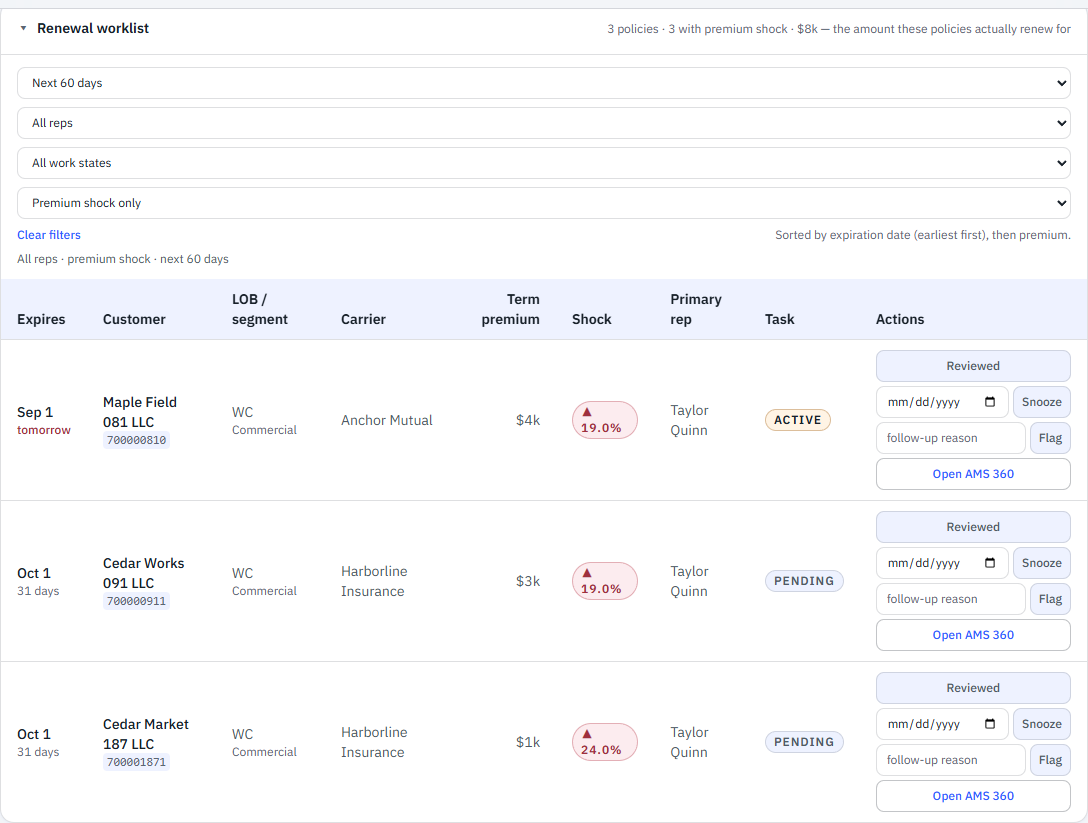
Choose and document a review threshold that fits the agency's Book and capacity. Keelridge's current worklist flags a change of 15% or more in either direction when a usable prior-term premium exists. A decrease matters too: it may be welcome, or it may signal a coverage, exposure, or data change that deserves attention. If no comparable prior premium exists, the change is unavailable—not zero and not automatically calm.
Which signals belong beside the percentage?
A workable queue keeps the decision context beside the alert. No single column should determine the outcome.
| Signal | Why it matters | What it does not prove |
|---|---|---|
| Expiration date | Shows how much time remains for review and communication | That the nearest renewal is the agency's largest exposure |
| Percentage change | Makes movement comparable across policies of different sizes | The cause of the change or whether it is unreasonable |
| Dollar change and current term premium | Shows the practical impact on the customer and the size of the account | That the largest account should always be handled first |
| Customer, carrier, and line | Provides relationship and market context for investigation | What changed in exposure, coverage, limits, or underwriting |
| Assigned account manager and review state | Makes ownership, follow-up, and workload visible | That a task was documented in the authoritative AMS record |
How far ahead should an agency review renewals?
There is no universal number of days that fits every line, carrier, and account. The agency needs enough lead time to gather updated exposure information, understand the renewal, communicate with the customer, and act when appropriate. A large commercial account and a simple personal-lines policy may require different service procedures.
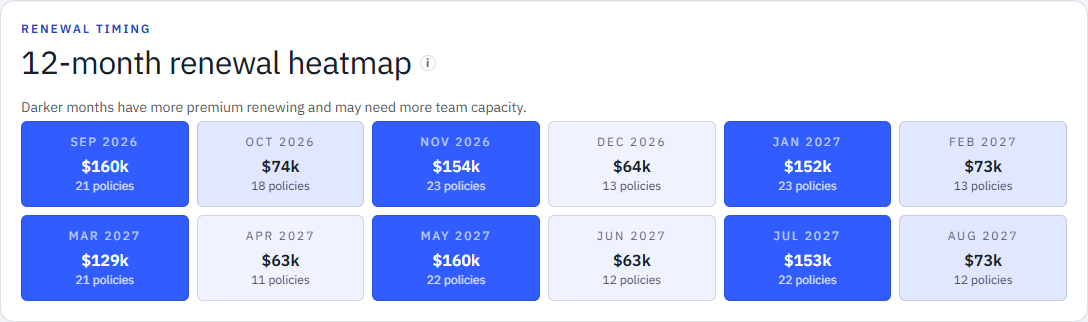
Use two horizons instead of forcing one list to do both jobs. A 12-month calendar reveals seasonal concentration and staffing pressure. A shorter rolling worklist—Keelridge currently uses the next 90 days—turns upcoming renewals into an actionable queue. Inside that queue, material changes lead, expiration proximity follows, and premium is only a tiebreaker rather than a public ranking of customers or employees.
How should an account manager investigate a flagged change?
Start by confirming that the comparison is genuinely like for like: the same policy relationship, a comparable term, and complete premium on both sides. Then review the current record and available renewal material for exposure, vehicle, property, payroll, sales, limit, deductible, coverage, audit, and carrier changes. A data mismatch can create a dramatic percentage just as easily as a real renewal movement.
The result is a service decision, not an analytics verdict. The account manager may need to explain the change, request information, discuss coverage, involve a producer or manager, document follow-up, or consider market alternatives under the agency's procedures. Keelridge does not recommend coverage, choose a carrier, or automatically remarket a policy.
What should a manager see across the team?
A department manager needs coverage and exceptions, not a leaderboard. The useful questions are whether upcoming premium is concentrated in a few months, which material changes remain unreviewed, where deadlines are approaching, and whether one person needs help with the queue.
The account manager should see their own policies and per-policy premium needed for service prioritization. The manager can see team workload and follow-up exceptions within their approved scope. Neither view needs agency-wide commission, profitability, or peer ranking to organize renewal work.
What does Keelridge automate each month?
Keelridge uses the recurring AMS Book feed to update renewal dates, current term premium, prior-term comparisons, and account responsibility. It builds the forward calendar, applies the documented premium-change rule, and carries lightweight reviewed, snoozed, and follow-up state beside the queue.
That removes the repeated work of finding comparable policies, calculating changes, sorting separate account-manager reports, and rebuilding a renewal spreadsheet. The AMS remains the authoritative system for service notes, coverage documentation, customer communication, and policy transactions. Keelridge organizes what deserves attention and sends the person back to the source system to complete the work.
Plan before the queue becomes urgent
The annual calendar shows when renewal workload is concentrated.
 Account manager viewOpen this page in the live demo →
Fictional Keelridge Demo Agency. The account-manager view shows when premium comes due so workload can be planned before the nearest renewals become urgent.
Turn the threshold into a review list
Material changes, timing, ownership, and follow-up stay together.
 Account manager viewOpen this page in the live demo →
Fictional Keelridge Demo Agency. The worklist uses premium change to focus human review; it does not label the cause or automatically remarket a policy.
A threshold should create attention, not an automatic answer
Compare like-for-like renewal terms, flag meaningful movement in both directions, and keep the percentage beside timing, dollars, account context, ownership, and review state. Then let the licensed account team decide what the evidence requires. The valuable automation is finding and organizing the work every month—not pretending the alert can perform the renewal review by itself.
Sources used for the industry context
- Applied Client Network — How Healthy Is Your Renewal Workflow?Current industry guidance on consistent thresholds, cumulative changes, workload visibility, and proactive renewal review.
- IA Magazine — 6 Ways to Boost Client Retention With a Renewal and Remarketing PlanIndependent-agency guidance on using AMS premium-change notifications as inputs to an adviser-led renewal process.
- Rough Notes — Unnecessary RemarketingAgency-operations perspective on the cost of reactive, automatic remarketing and the need for earlier, intentional review.